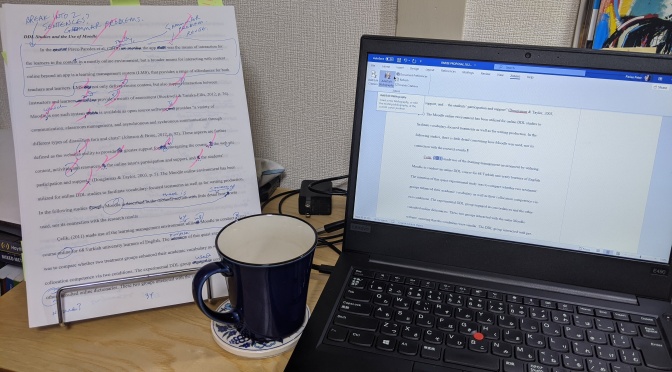
Sunday evening, finished the presentation. Thank you Anne for working with me on this. I appreciate it a lot! It is much easier to present as a pair than alone. Ibaraki JALT is a fine group of people! Thank you for your support and warm-heartedness.  Tom and Yasue’s presentation was excellent too! Thank you for doing this with us!

Now, I am just going to vegetate for a bit. Put the books and the papers away! Tomorrow’s another day. Tomorrow’s a work day. Tomorrow never knows…..

Presentation in Ibaraki!

February 18, 2012

Reblogged from TESOL_Peter:

I will be giving a presentation on techniques to improve spoken fluency with Anne Takata on February 19, 2012 for the Ibaraki JALT chapter in Japan. For more information here is the link to the Ibaraki JALT. Hope to see you there. Date: February 19th Time: 1 p.m. to 5 p.m. Room no: Sho-kouzashitsu #2 (Small-sized Room #2) Place: Ibaraki Kennan Gakushu Center (in Urara Building, 5th Floor) 2:40 – 4:00 (1 hour to talk and 20 for QA) Peter Parise and Anne Takata Abstract Fluency? Fluency. Fluency!: Practical …

Just another subtle reminder… fluency is in Ibaraki tomorrow!

流暢?流暢。流暢!:流暢さの発達への実践的・理論的取り組み

(Fluency? Fluency. Fluency!: Practical and theoretical approaches to fluency development.)

Peter Parise and Anne Takata

日本人英語学習者は、文法と語彙において確かな知識をもっており、流暢さの発達の下準備ができています。今回の発表では、様々な学力差やクラスの内容に対応できる手軽で効果的な流暢さを発展させる言語活動を紹介します。ここでは、理論的・実践的な使用における討議も行われます。

Presentation in Ibaraki!

January 27, 2012

I will be giving a presentation on techniques to improve spoken fluency with Anne Takata on February 19, 2012 for the Ibaraki JALT chapter in Japan. For more information here is the link to the Ibaraki JALT. Hope to see you there.

Date: February 19th
Time: 1 p.m. to 5 p.m.
Room no: Sho-kouzashitsu #2 (Small-sized Room #2)
Place: Ibaraki Kennan Gakushu Center (in Urara Building, 5th Floor)
2:40 – 4:00 (1 hour to talk and 20 for QA)

Peter Parise and Anne Takata

Abstract

Fluency? Fluency. Fluency!: Practical and theoretical approaches to fluency development.

Armed with a firm background in grammar and lexis, Japanese EFL students are well primed for fluency development. This presentation will demonstrate a simple and effective fluency activity that is suitable for a wide range of levels and class contexts. Both theoretical and practical uses will be discussed.

_______________________________________________

For a PDF of the power point  and reference list go here

日本語の抄録ここにクリック

Highlights of the past year was getting published in a book by the JALT CALL sig called CALL:What’s Your Motivation? in which I wrote an article about Wordle and how it can be useful in the language classroom.

While it is great to write about other web-based applications, especially ones that can help with data-driven learning, this year I also want to focus on my own studies, maybe in relation to these applications or something related with language learning in general. Stay tuned for more in the months ahead.

Hey everyone,

In Japan the academic year starts in April. Just in time for the cherry blossoms. I know this has been a tough year so far, with the earthquake, tsunami, and now the reactors which are over 100 km away from me. Based on the picture above, I want to say that no matter how bad things get, there will always be hope.

Like everyone else here, I will keep going and do my best teaching and researching.

Thank you, and good luck

Tidying up

September 16, 2010

Hello all,

I want to say that it has been a while. While I have been enjoying my summer, I have also been wrapped up in writing. I finished a submission to the proceedings for the JALT CALL 2010 Conference, so please read it when you can.

Also I found, almost accidentally that the David Lee Corpus Links hyperlink for my ever popular guide to corpus tools was not working, and went to a dead-end. I just added a new link to the screenshot, so just click on it and it will connect you. I hope this will help.

Take care,

Hello everybody,

Just wanted to give you notice that I will be giving a workshop at the JALT CALL 2010. (Thats the Japan Association of Language Teachers Computer Assisted Language Learning conference in case you don’t live in Japan)

The title of this workshop is devoted to one internet tool Wordle, created by Johnathan Feinberg.   I am offering this here make teachers in Japan aware of its potential. We will create some word clouds in the lab and group brainstorm ideas on applying them in the classroom.

You too can witness the action because I am presenting this via Google Docs Presentation software, which can allow users to see the presentation online!

here is the link to the presentation.

I will be giving this on Sunday, May 30th at from 9:30 am to 11 am Japan time.  I look forward to your participation.

http://docs.google.com/present/view?id=df3h5zmc_122fpf58zdf&invite=CJny86AH

Wordle: High Fequency Words in Oral Communication Textbook

Wordle: High Frequency Words In Oral Communication Textbook_with Fucntion Words

I found one interesting website which uses word frequencies to create word clouds, that is http://www.wordle.net created by Johnathan Feinberg. I created these clouds from one of my high school’s Oral Communication textbook and made a giant print for that schools faculty art exhibition. This seems like a more visually pleasing way to present word frequencies to students in contrast with ranked frequency lists.  I am curious about how other teachers would use this material in their classrooms.

If you go to the site, you have the option of uploading a text and creating a composition. Also you can also use links to get material directly from the internet, and you can also gather tags from a del.ici.ous user. Give it a try and see for yourself.

http://www.wordle.net/show/wrdl/1643810/High_Fequency_Words_in_Oral_Communication_Textbook

To twitter or not to twitter?

November 28, 2009

That is the question.

I must admit that the concept of using twitter is enticing. Based on what I read from one twitter publication A Geek’s Guide To Promoting Yourself and Your Online Business in 140 Characters or Less with Twitter ( I love the title) offers advice on how to use your 14o characters to draw readers to your blog or online business. I have the pdf so just click the title.

In terms of language teaching, it is seen as an ideal way to keep in contact with your colleagues. One piece written by Ted O’Neil for JALT’s The Language Teacher gives some detailed advice on how to apply it as means of idea exchange. This is especially applies to conferences where so many events and lectures are happening at once. The link is here to the publication site.  I went to the JALT conference in Shizuoka last week, and even though I wasn’t using the service, I know of some other colleagues who probably would benefit from some other persons tweet, particularly if it is about  a presentation  or lecture that they had missed.

I would like to hear what your position is on using or not using Twitter. I have yet to make a decision. Maybe some more contemplation is in order.

To twitter or not to twitter? Hmmmm….

Follow

Get every new post delivered to your Inbox.